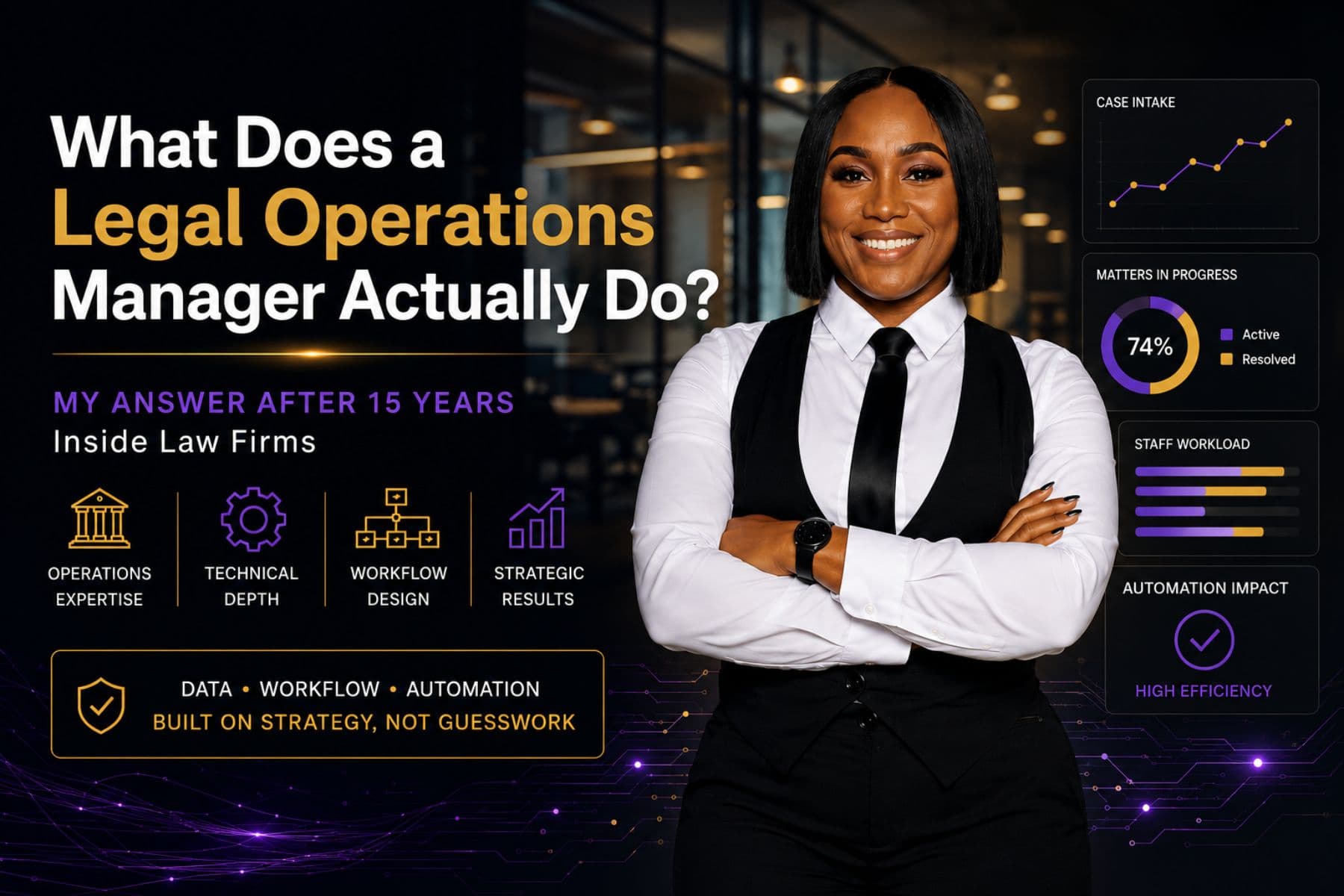
What Does a Legal Operations Manager Actually Do? My Answer After 15 Years Inside Law Firms
By Teila Garraway, Founder and Principal Consultant
Most people in this field came up through one lane — legal, or tech, never both at once. I didn't. And that's the reason I can see what most consultants in this space can't.
Right now, firms are pouring more money into legal technology than at any point I've seen in this industry. A lot of them finish the rollout and end up right back where they started: same broken process, just running on a newer platform.
How a Software Purchase Actually Falls Apart
Here's the pattern I've watched repeat, project after project. A vendor sells a firm on a platform. Once the contract's signed, an outside implementation team gets brought in to handle the technical side of the switch — and their job stops at moving data from the old system into the new one. Nobody on that team is accountable for whether the workflow actually fits how the firm operates, whether staff will use it, or whether the data was clean enough to migrate correctly in the first place.
So six months later, adoption stalls. The vendor says that's an implementation problem. The implementation team says that's a vendor problem. Neither one owns what actually happened, and the firm is stuck paying for software nobody's touching.
That's not bad luck. It's how the industry is structured. And it's the exact gap SourcePro Consultants was built to close.
A legal operations manager's real job has almost nothing to do with what people assume. It's not staffing decisions. It's not just picking which platform to buy. The job is owning the link between how a firm actually functions day to day and the technology sitting on top of that. In small and mid-sized firms, that link almost never has anyone responsible for it.

Why My Background Looks Different From Everyone Else's in This Space
I didn't set out to become this. I built toward it, one role at a time, because the person who could actually sit between a firm and its vendors — and protect the firm's side of that relationship — didn't exist yet.
It started at State Farm, on the personal injury side of a Florida external counsel office. I supervised staff, rebuilt how intake got handled, put structure around the case management system so the whole team could actually adopt it, and wrote the SOPs that governed case movement. Looking back, that was legal operations work — I just didn't have the title for it yet, and none of the AI tooling that exists now was anywhere near ready.
From there I moved to Progressive in Atlanta, first supporting attorneys directly, then training them. Those training sessions eventually got a nickname around the office — Teila's Tech Tip Tuesdays. Running them for years taught me something I couldn't have learned any other way: which firms actually got value out of new systems, and which ones just swapped one mess for a different-looking mess. I could see the pattern behind both outcomes.
While I was still at Progressive, I went through Digital Crafts' full-stack bootcamp and finished a BBA in Information Technology at Liberty University. That combination changed how I thought about the whole problem. I started working as a software engineer — building and testing enterprise applications with .NET Core and Playwright — not to leave legal operations behind, but because I'd realized the technical and operational sides of a firm can't be designed separately. You need real fluency in both, or you're only ever solving half the problem.
What That Combination Actually Looks Like in Practice
That's the foundation SourcePro is built on. We design how the operation should work before you buy anything. Tool selection comes after the architecture is set, not before — the software gets chosen to fit the design, not the other way around. We sit between you and your vendors and argue for your interests specifically. We handle the actual migration. We train your staff on the new system. We build the dashboards that give leadership real visibility into what's happening operationally. And once the workflow is solid, we layer automation and AI on top of it.
We're not a software vendor, and we're not a generalist consultant either. We're closer to an operational architect — and that specific combination isn't something a typical vendor relationship or a generic consulting engagement can offer. Years inside two of the country's largest insurance litigation operations, a real software engineering background, and the ability to actually build the automation we design — that mix is rare, and it's not something you can fake your way into. It's what makes it possible to get a firm's operational structure right before any technology touches it. When that happens, the software finally does what the sales pitch promised.

Why This Matters Most for Firms That Aren't Large Yet
Big firms solved this problem a while ago. They have in-house project managers, data people, and technology staff whose entire job is exactly this. If you look at a real legal operations job description at a firm large enough to build that function internally, this is what it covers.
Firms below that size don't have the budget or headcount to build the same internal team — but they're still competing against firms that do, in a legal technology market that's moving faster than most owners have time to evaluate on their own. That's where I see the real money get lost. Not from weak lawyering. From technology decisions made without anyone in the room who actually understands both the operational and technical sides well enough to be accountable for the outcome.
SourcePro functions as that internal team, without the overhead of hiring one. You bring us in for the specific project you need, when you need it, instead of building a department around a function you only need occasionally. It's the same logic behind bringing in a fractional COO for law firms rather than committing to a full-time hire before the firm's actually ready for one.
We act as the firm's advocate in a market that's crowded with new tools and new "experts" who've built software but have never actually worked a day inside a law firm.
If This Sounds Familiar
If you've ever felt the distance between what a piece of legal technology was supposed to do for your firm and what it actually delivered, that distance has a specific cause. It's not a software failure. It's that nobody owns the operational layer the software is supposed to sit on top of.
Want to know if that's happening at your firm? Learn More about a Legal Systems Health Check

Teila Garraway
Founder and Principal Consultant
15+ years paralegal and legal operations experience, plus a full-stack software engineering background.
About Teila →