
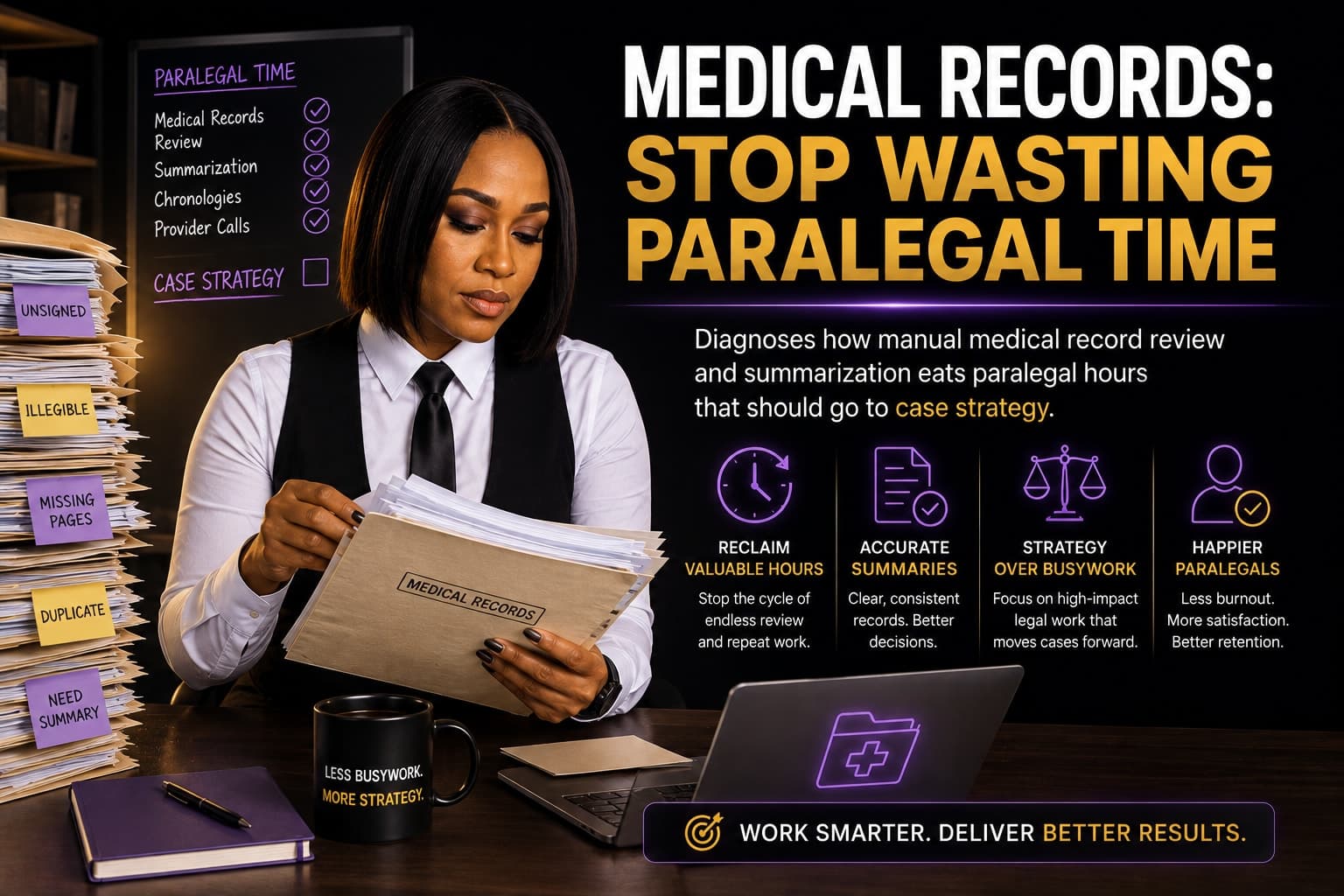
Medical Records: Stop Wasting Paralegal Time
By Teila Garraway, Founder and Principal Consultant
A paralegal opens a 400-page medical records file. Sets a timer. An hour later, they've built a rough chronology by hand — flagging injury dates, treatment gaps, provider names, prior conditions. Multiply that by every open PI case on the docket, every week, for every paralegal at the firm.
That's not case work. That's data entry with a law degree's worth of context wasted on it.
Medical chronology software exists specifically to eliminate this. But most firms either haven't adopted it, or adopted it without building the workflow around it — which means the tool sits unused while paralegals keep doing it by hand.
The Cost of Manual Medical Records Processing
In a personal injury firm, medical records review is one of the highest-volume, most repetitive tasks on the calendar:
Every new case requires pulling and organizing potentially hundreds of pages of records
A paralegal manually builds the chronology — dates, providers, diagnoses, treatment history, gaps in care
This process typically takes 45 minutes to over an hour per case, depending on file size
Multiply that across an active caseload and it's dozens of hours per week spent on manual review
That time isn't billable in most fee structures, and it isn't spent on case strategy, client communication, or intake
The business impact compounds:
Lost capacity: hours spent on manual chronology building are hours not spent moving cases forward
Slower case velocity: cases wait longer to get to demand letters or settlement negotiations
Staff burnout: repetitive, low-value manual work is a top driver of paralegal turnover
Revenue drag: every hour a paralegal spends on manual data entry is an hour of firm capacity that isn't converting to case throughput
Where AI Medical Chronology Fits in the Firm
AI medical chronology tools don't replace the paralegal's judgment. They replace the manual first pass — the hours spent extracting and organizing raw data before any actual analysis happens.
Before: Records arrive, paralegal manually reads every page, builds a chronology by hand in a document or spreadsheet, this takes 45 minutes to over an hour per case, the chronology is often inconsistent in format from paralegal to paralegal.
After: Records are uploaded, automation extracts and organizes dates, providers, diagnoses, and treatment gaps into a structured chronology, what took an hour now takes about two minutes to generate, the paralegal reviews and refines the AI-generated draft instead of building it from scratch, chronology format is consistent across every case and every paralegal.
That's the difference between a paralegal spending their week on data entry versus spending it on the parts of case work that actually require their expertise.

Common Mistakes Firms Make With Medical Records Automation
Mistake 1: Buying the tool without redesigning the intake-to-chronology workflow.
Medical chronology services and AI tools both promise time savings, but if records still arrive in inconsistent formats, get routed inconsistently, and nobody owns quality-checking the output, the firm doesn't actually save the time it expected to.
Mistake 2: Treating AI output as final instead of a first draft.
AI medical records summary for lawyers tools are strong at extraction and organization. They are not a substitute for a paralegal's clinical and legal judgment. Firms that skip the human review step introduce risk into demand letters and case strategy.
Mistake 3: No standard for what "done" looks like.
Without a defined chronology format and review checklist, every case ends up structured differently — which defeats the consistency automation is supposed to provide.
Mistake 4: Rolling it out firm-wide without piloting first.
Automation that isn't tested against a firm's actual document types and case complexity first tends to underperform expectations and get abandoned quietly within a few months.
How to Implement Medical Records Automation
Standardize how records arrive. Define intake formats and routing before automation touches a single file.
Pilot on a defined case type. Start with one practice area or injury type before rolling out firm-wide.
Build a review checklist. Every AI-generated chronology gets checked against a defined standard before it's used in case strategy or a demand letter.
Assign clear ownership. Someone owns quality control on the automated output — this isn't a "set it and walk away" tool.
Track time savings. Measure hours per case before and after to prove the ROI and refine the workflow.
Redeploy recovered time deliberately. Freed-up paralegal hours should go to higher-value work — case strategy, client communication, intake support — not just absorbed into more caseload without a plan.

Diagnostic Questions for Your Firm
How many hours per week does your team currently spend manually building medical chronologies?
If you already have medical chronology software or an AI tool available, is it actually being used consistently — or did adoption stall after rollout?
Does every paralegal at your firm build chronologies the same way, or does format vary case to case?
What would your paralegals do with 10 recovered hours a week if manual record review wasn't consuming them?
The Bottom Line
Medical records processing is one of the clearest places in a PI firm where manual work is quietly costing real money. Personal injury medical chronology automation isn't about replacing paralegals — it's about giving back the hours currently lost to data entry so that expertise gets spent where it actually matters.
The CRM is the tool. The system design is the product. If your team is still building chronologies by hand, the software was never the problem — the workflow around it was.
Not sure how much time your team is actually losing to manual work like this? Run the free Law Firm Realization Rate Calculator: https://tools.sourceproconsultants.com/realization-calculator/. Browse all free tools at https://sourceproconsultants.com/tools-resources.
Ready to stop wasting paralegal time on manual record review? Book a Legal Systems Health Check: https://sourceproconsultants.com/legal-systems-health-check

Teila Garraway
Founder and Principal Consultant
15+ years paralegal and legal operations experience, plus a full-stack software engineering background.
About Teila →